
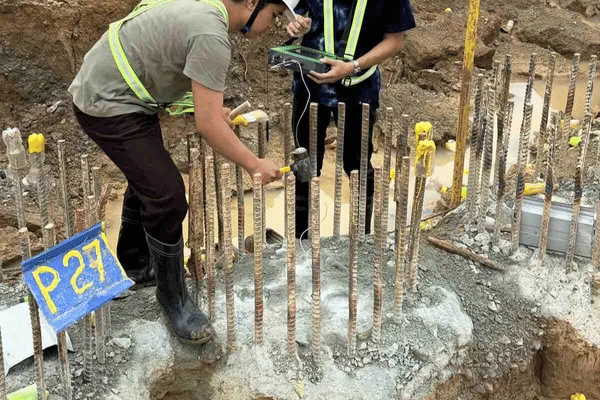
Construction projects depend on materials that can perform according to their intended specifications. Grout is one such material. It may be used for masonry construction, structural connections, equipment bases, foundations, repair work, and other engineered applications. Since grout can become part of a load-bearing assembly, its quality deserves careful attention.
Grout integrity testing Philippines gives engineers, contractors, developers, and project owners a practical way to obtain measurable information about grout quality. Proper sampling, specimen preparation, curing, testing, and technical reporting can help determine whether grout meets project requirements.
Grout may look sound after placement, yet visual inspection alone cannot confirm its compressive strength or other material properties. Laboratory testing provides objective measurements that can support construction quality control and engineering review.
Inch-On Materials Testing Laboratory is a DPWH-BRS accredited Engineering and Construction Laboratory established in November 2018. The laboratory provides testing services for soil and construction materials and also performs selected field testing for soil, concrete, and foundation piles. Its testing activities follow applicable ASTM and AASHTO procedures.
For projects requiring grout integrity testing Philippines, selecting an appropriate testing method should always start with the project specification, grout type, specimen requirements, and applicable standard.
What Is Grout Integrity Testing?
Grout integrity testing refers to testing procedures used to evaluate selected properties of grout and determine whether the material meets specified requirements.
The exact testing approach depends on the type of grout and its intended application. Masonry grout, non-shrink grout, hydraulic cement grout, and grout used for specialized construction applications may require different procedures.
For masonry construction, ASTM C1019 covers field and laboratory sampling and compression testing of grout. ASTM describes this method as useful for evaluating grout proportions and for quality control related to uniformity of grout preparation during construction.
A Grout integrity testing Philippines program may therefore involve:
- Proper grout sampling
- Specimen identification
- Specimen preparation
- Controlled curing
- Compressive strength testing
- Density evaluation where specified
- Documentation of sample age and test conditions
- Technical reporting
- Comparison of measured results with applicable project requirements
Testing should not be treated as a substitute for proper grout placement, consolidation, curing, or construction supervision. Rather, test results provide measurable information that can support a broader quality-control program.
Why Grout Quality Matters for Philippine Construction Projects
Grout can serve several important functions within a construction assembly. Its performance may affect connections, masonry systems, equipment supports, foundation-related applications, and repair work.
Poor material preparation, unsuitable proportions, inadequate curing, contamination, improper placement, or insufficient consolidation may affect final performance. Testing can help identify whether selected specimens achieve the required properties.
Grout integrity testing Philippines is particularly useful when project specifications require documented evidence of material performance.
Supports Structural Performance
Where grout forms part of a structural connection or masonry system, its specified properties should be verified through appropriate testing and inspection procedures.
Engineers may need documented strength results before approving a construction stage or accepting a particular batch.
Helps Identify Low-Strength Materials
A grout batch that does not achieve its specified strength may require additional investigation. Early identification can give the project team an opportunity to review placement, curing, mix preparation, or other contributing factors.
Supports Construction Quality Control
Laboratory results create measurable records that can be included within project quality documentation. These records may assist contractors, engineers, inspectors, and project owners during construction review.
Provides Technical Documentation
A properly prepared laboratory report can record sample identification, testing dates, specimen age, measured results, and other relevant information. Such documentation can support engineering assessment and project records.
What Does Grout Integrity Testing Philippines Evaluate?
The properties evaluated depend on the project requirements and applicable test method. Several factors may be relevant.
Compressive Strength
Compressive strength is one of the most important properties for many cement-based grout applications. A compressive strength test measures how much load a prepared specimen can withstand under compression.
For masonry grout, ASTM C1019 specifically addresses sampling and compression testing.
For hydraulic cement non-shrink grout, DPWH materials-testing documentation also identifies ASTM C109 for compressive strength testing.
The correct test method should therefore be selected based on the grout type and project specification rather than assuming that one procedure applies to every grout application.
Density
Density can be an important measurement for selected grout applications. DPWH quality-assurance guidance for jet grouting identifies both compressive strength and density testing for grout cubes.
Density results may provide useful information about material consistency when required by the project.
Curing Condition
Curing can affect the development of cementitious grout strength. Specimens need to be prepared and cured according to the applicable testing procedure.
ASTM C1019 also notes that its specimen conditions do not exactly reproduce every physical exposure condition experienced by grout within a wall. This distinction matters when engineers interpret laboratory results.
Specimen Condition
Sample identification, preparation, dimensions, handling, curing, and test age all matter. A laboratory result is meaningful only when the specimen and testing process are properly documented.
Internal Quality Concerns
Voids, incomplete filling, poor consolidation, segregation, or other placement concerns may require additional engineering investigation. A routine strength test does not automatically identify every internal defect.
For suspected defects within an existing structure, the appropriate investigation method should be selected by the responsible engineer or qualified testing professional.
Common Applications That May Require Grout Testing
Grout appears across numerous construction activities. The testing requirements should always match the specific application.
Masonry Construction
Grout may be placed within reinforced masonry cells or other masonry assemblies. ASTM C1019 specifically covers grout used for masonry construction.
Testing may help verify whether prepared specimens achieve the required strength.
Structural Connections
Some structural assemblies depend on grout for connection, bearing, leveling, or load-transfer functions. Project specifications may require documented testing before acceptance.
Equipment Bases
Non-shrink grout may be used below equipment or machinery bases. Such applications can require controlled material preparation and verification of specified properties.
Foundation Applications
Certain foundation-related construction methods use cementitious grout as part of the installation process. DPWH quality-assurance guidance identifies grout cube compressive strength and density tests for jet grouting work.
Repair and Rehabilitation
Grout can also form part of repair systems. Testing requirements for repair work should be established according to the repair design, material manufacturer’s requirements, engineering specifications, and applicable standards.
How Grout Integrity Testing Is Performed
A successful Grout integrity testing Philippines program begins before testing day. Proper coordination helps ensure that specimens are representative, traceable, and suitable for the selected test.
Step 1: Review Project Requirements
The first step is reviewing the construction specification and engineering requirements.
Important information may include:
- Grout type
- Required compressive strength
- Required testing age
- Sampling frequency
- Number of specimens
- Applicable test method
- Curing requirements
- Reporting requirements
Step 2: Collect and Identify Samples
Representative samples should be collected according to the applicable procedure. Each specimen or sample should be properly identified.
Relevant information can include the project name, location, batch information, sampling date, grout type, and other project-specific details.
Step 3: Prepare Specimens
Specimens should be prepared according to the selected testing standard. Proper preparation helps reduce avoidable sources of testing variation.
Step 4: Cure Specimens
Controlled curing forms an important part of laboratory testing. Specimens should remain under the conditions required by the applicable procedure until the designated testing age.
Step 5: Conduct Laboratory Testing
Laboratory personnel perform the selected test using appropriate equipment and procedures.
For masonry grout, ASTM C1019 provides procedures for sampling and compression testing.
For non-shrink hydraulic cement grout, DPWH documentation identifies ASTM C109 for compressive strength testing.
Step 6: Review and Report Results
The final stage involves recording and presenting the measured results. DPWH’s own laboratory worksheet for concrete compressive strength, for example, includes information such as sample identification, specimen type, sampling date, age, cross-sectional area, maximum load, and compressive strength.
A clear report allows project personnel to review test information against the applicable specification.
ASTM Standards and Grout Testing
ASTM standards provide standardized procedures for numerous construction-material tests. Selecting the correct standard is essential because different materials and applications require different testing approaches.
ASTM C1019 covers sampling and testing grout used for masonry construction. Its scope includes both field and laboratory sampling and compression testing.
ASTM C109 is used for compressive strength testing of hydraulic cement mortar and is identified by DPWH documentation for non-shrink hydraulic cement grout testing.
ASTM C140/C140M covers sampling and testing concrete masonry units and related units, including properties such as dimensions, compressive strength, absorption, density, and moisture content.
This distinction is important for projects involving both grout and concrete hollow blocks. ASTM C140/C140M addresses masonry units, while ASTM C1019 addresses grout used for masonry construction.
DPWH’s quality-testing guidance also identifies concrete hollow block testing procedures under ASTM C90 and ASTM C140M, including compressive strength, absorption, density, and related measurements.
Therefore, a professional Grout integrity testing Philippines service should identify the correct standard based on the material being tested rather than applying one ASTM designation across all construction materials.
Laboratory Testing vs. Field Testing for Grout Quality
Laboratory and field testing serve different purposes.
Laboratory testing provides controlled conditions for evaluating collected specimens. Field testing evaluates selected conditions directly at a project site.
Inch-On Materials Testing Laboratory provides both laboratory and field testing services. Its field testing activities include in-situ evaluation of soil, concrete, and foundation piles, while its laboratory services cover quality evaluation of soil and construction materials.
For a project requiring Grout integrity testing Philippines, the appropriate combination of laboratory and field services depends on the project scope and engineering requirements.
A typical quality-control process may involve:
- Project specification review
- Material sampling
- Field documentation
- Specimen preparation
- Laboratory curing
- Laboratory testing
- Result review
- Technical reporting
Signs That a Project May Need Grout Integrity Testing
Several situations may justify grout testing or further technical review.
Testing may be appropriate when:
- Project specifications require grout strength verification.
- A new grout mix is being introduced.
- A batch may have been mixed incorrectly.
- Curing conditions were questionable.
- Grout placement was interrupted.
- Visible defects have appeared.
- Voids or incomplete filling are suspected.
- An engineer requests material verification.
- A project requires formal quality-control records.
- Grout performance forms part of an important structural or equipment-support application.
Testing should be planned early enough to meet the required sampling and testing schedule.
How Poor Grout Quality Can Affect Construction
Grout quality concerns can create technical and project-management challenges.
Reduced Performance
If grout fails to achieve its specified properties, the intended performance of an assembly may require further engineering review.
Additional Investigation
Unexpected test results may lead to additional sampling, testing, inspection, or structural assessment.
Construction Delays
A failed or unavailable test result may affect approval of subsequent work when project procedures require material verification before progression.
Additional Costs
Early quality control can help identify material concerns before they become more extensive construction problems.
These outcomes are not automatic consequences of every low test result. Engineers should evaluate results based on the project specification, testing method, specimen history, and construction conditions.
Why Choose Inch-On Materials Testing Laboratory?
Inch-On Materials Testing Laboratory provides construction-material testing services designed to support engineering and construction quality requirements.
DPWH-BRS Accredited Laboratory
Inch-On Materials Testing Laboratory is a DPWH-BRS accredited Engineering and Construction Laboratory established in November 2018.
Its accreditation provides an important reference point for project teams seeking a laboratory operating within established regulatory and technical requirements.
ASTM and AASHTO Testing Practices
The laboratory follows applicable ASTM and AASHTO testing standards for its testing activities.
Standardized procedures help create consistent methods for sampling, specimen preparation, measurement, and reporting.
Laboratory Testing Services
Laboratory testing provides controlled conditions for evaluating construction materials. This can support quality verification for projects that require documented material results.
Field Testing Services
Inch-On also conducts field testing involving soil, concrete, and foundation piles. Site-based testing can provide additional information about actual project conditions.
Specialized Equipment
Construction material testing depends on suitable equipment, proper calibration, trained personnel, and controlled procedures. Inch-On uses specialized testing equipment as part of its laboratory and field services.
Technical Reports
Clear technical reports help engineers, contractors, project owners, and inspectors review measured results. Proper documentation also supports project quality records.
What to Prepare Before Requesting Grout Integrity Testing
Project teams can help streamline testing by preparing relevant technical information before submitting samples.
Useful information may include:
- Project name
- Project location
- Grout type
- Manufacturer or product information
- Mix information
- Required strength
- Sampling date
- Specimen age
- Required testing date
- Applicable project specification
- Required ASTM or AASHTO procedure
- Number of specimens
- Special reporting requirements
If the appropriate testing method is uncertain, the project engineer and testing laboratory should review the material and specification before specimen preparation.
How Grout Testing Supports Construction Quality Control
Grout integrity testing Philippines works best as part of a broader quality-control system.
Quality control begins with suitable materials and continues through proportioning, mixing, placement, consolidation, curing, sampling, laboratory testing, and documentation.
A laboratory result provides a measured value. Engineers then interpret that value against the applicable specification and the history of the specimen.
This approach can help project teams maintain organized material records and identify potential concerns before they affect later construction stages.
Testing should therefore be considered during project planning rather than only after a suspected material problem develops.
Choosing a Grout Testing Laboratory in the Philippines
Choosing a laboratory requires more than checking whether a company offers material testing. Project teams should examine the laboratory’s technical capabilities and applicable accreditation.
Check Laboratory Accreditation
Confirm the laboratory’s relevant accreditation and testing scope.
Review Applicable Standards
Ask which ASTM, AASHTO, DPWH, or project-specific procedures apply to the requested test.
Ask About Equipment
Appropriate testing equipment and calibration are important parts of laboratory quality.
Confirm Sampling Procedures
Ask how samples are received, identified, prepared, cured, and tested.
Request Clear Reports
A useful report should provide enough information for the project team to understand what was tested, which method was used, and what results were obtained.
These considerations can help contractors and engineers establish a testing process suited to their project.
Grout Integrity Testing Philippines: A Practical Quality-Control Step
Grout can serve an important function within masonry, structural, foundation, equipment-support, and other construction applications. Its appearance alone cannot establish whether it has achieved the required material properties.
Grout integrity testing Philippines provides measurable information that can support quality control, engineering review, and construction documentation.
Proper sampling, specimen preparation, curing, testing, and reporting all contribute to meaningful laboratory results. The applicable testing standard should always match the material and intended application.
For projects involving grout, concrete, concrete hollow blocks, soil, or other construction materials, Inch-On Materials Testing Laboratory provides laboratory and field testing services backed by its DPWH-BRS accreditation and established ASTM and AASHTO testing practices.
Takeaway
Grout integrity testing Philippines can provide valuable measurable information for construction projects where grout performance matters. Proper testing helps project teams document material properties, support quality-control procedures, and provide engineers with data for technical review.
The correct testing method depends on the grout type, application, specimen, project specification, and applicable standard. ASTM C1019 covers sampling and testing of masonry grout, while other grout applications may require different procedures. DPWH documents also identify specific grout testing requirements for selected construction activities.
For dependable construction material evaluation, Inch-On Materials Testing Laboratory combines laboratory and field testing capabilities with DPWH-BRS accreditation and established ASTM and AASHTO testing practices.
Need grout, concrete, CHB, soil, or other construction material testing for your project? Contact Inch-On Materials Testing Laboratory to discuss the appropriate testing requirements and documentation for your project.
Frequently Asked Questions About Grout Integrity Testing Philippines
What is grout integrity testing?
Grout integrity testing involves appropriate laboratory or field procedures used to evaluate selected properties of grout. Depending on the material and project requirements, testing may include compressive strength, density, or other specified properties.
Why is grout testing important?
Testing provides measurable data that can help determine whether grout meets project requirements. It can also support construction quality-control records and engineering review.
What test is commonly used for masonry grout?
ASTM C1019 covers sampling and compression testing of grout used for masonry construction. The specific procedure should be confirmed against the project specification and grout application.
Does grout integrity testing include compressive strength testing?
It can. Compressive strength is a common property evaluated for grout, but the applicable test method depends on the type of grout and its intended use.
What ASTM standard applies to masonry grout?
ASTM C1019 covers sampling and testing of grout used for masonry construction.
Is ASTM C140 used for grout testing?
ASTM C140/C140M primarily addresses concrete masonry units and related units. It covers properties such as dimensions, compressive strength, absorption, density, and moisture content. It should not automatically be treated as the testing standard for masonry grout.
What standard may apply to non-shrink grout?
The appropriate method depends on the specific product and project requirements. DPWH documentation identifies ASTM C109 for compressive strength testing of hydraulic cement non-shrink grout.
Can grout samples be tested by a materials testing laboratory?
Yes. Laboratory testing can provide controlled conditions for specimen preparation, curing, testing, measurement, and reporting, subject to the applicable test procedure.
When should grout testing be arranged?
Testing should ideally be planned before grout placement and sampling. Early coordination helps ensure that the required specimens, sampling procedures, curing conditions, and testing ages are properly established.
Does Inch-On Materials Testing Laboratory provide construction material testing?
Yes. Inch-On Materials Testing Laboratory provides laboratory testing for soil and construction materials, along with field testing services involving soil, concrete, and foundation piles.
How can I request Grout integrity testing Philippines?
Project teams can contact Inch-On Materials Testing Laboratory with the project specification, grout type, required strength, sampling details, and requested testing requirements. The appropriate testing method can then be established according to the project needs.