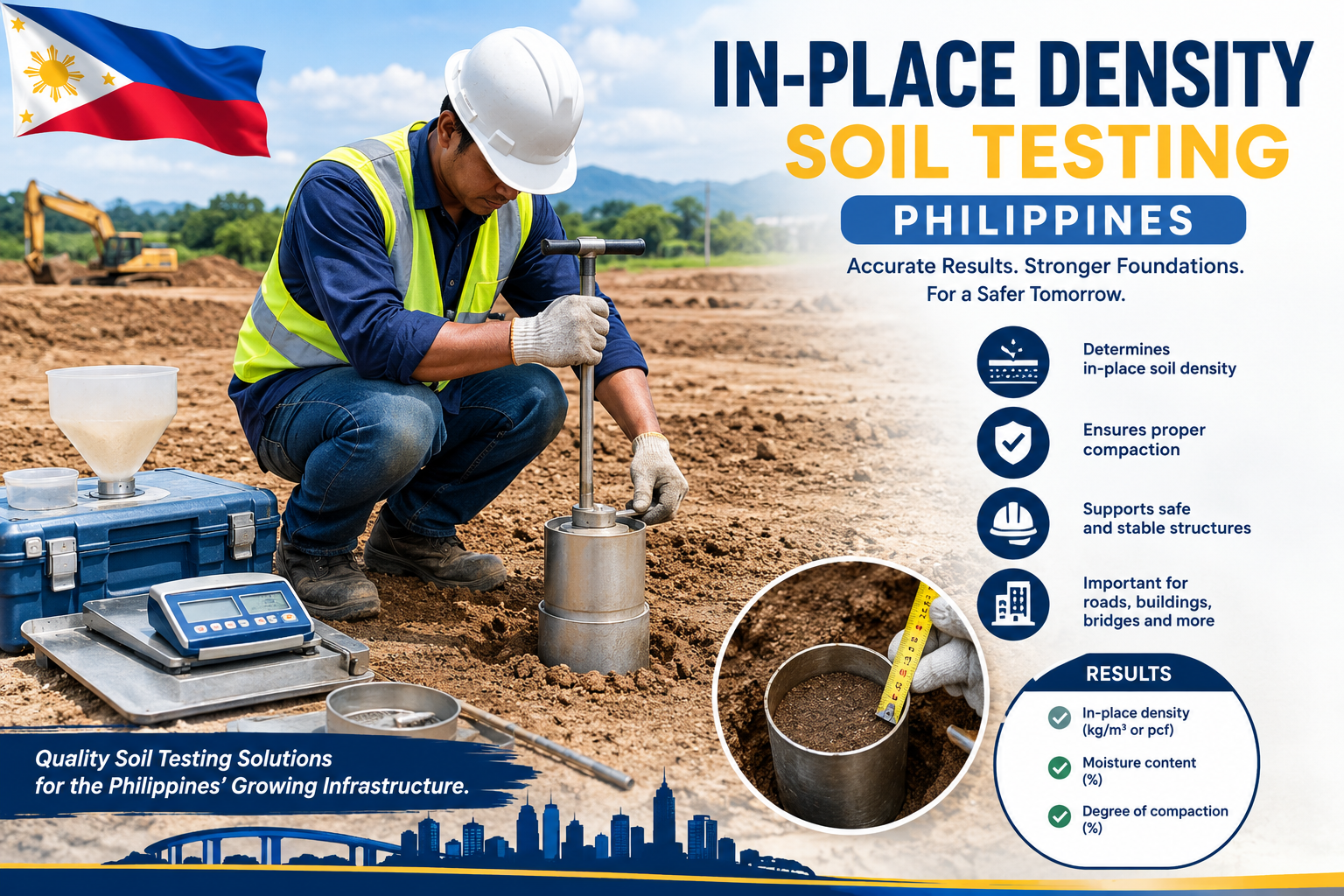
Soil provides the foundation for many construction activities, from building developments and road networks to industrial facilities and infrastructure projects. While structural materials such as concrete and steel receive considerable attention, the condition of the soil beneath a project can have an equally important role in overall performance. Proper soil placement and compaction can help create a more stable construction platform and support the loads imposed by completed structures. This is why In-place density soil Philippines testing is an important consideration for projects that involve compacted soil, fill, embankments, subgrades, or backfill. Field density testing allows construction professionals to measure soil conditions directly at the job site. These measurements can then be evaluated against appropriate laboratory references and project requirements.
Understanding In-Place Soil Density
In-place soil density refers to the density of soil as it exists within a particular location at a construction site. Unlike a laboratory specimen prepared under controlled conditions, an in-place measurement represents actual field conditions. The measurement can be useful for evaluating soil that has been placed and compacted as part of construction activities. Depending on the selected test method, field measurements can include density, moisture content, and other related information. This data can help engineers and contractors determine whether a compacted soil layer is performing within the requirements established for the project.
Density generally describes the amount of mass contained within a given volume. For soil-compaction work, dry density is particularly useful because it removes the influence of water from the density calculation. Moisture content is therefore often measured alongside field density. Together, these measurements provide a clearer picture of the condition of compacted soil. For projects searching for In-place density soil Philippines services, understanding this basic relationship makes it easier to appreciate why field testing is performed. It also helps project teams interpret test reports and communicate effectively with testing professionals.
Why Soil Compaction Deserves Attention
Soil compaction is an important part of earthwork because placed soil can contain air voids that affect its behavior under load. Mechanical compaction applies energy to the soil and encourages particles to move into a more closely packed arrangement. When the process is performed appropriately, it can improve the consistency and stability of the prepared layer. However, the amount of compaction required varies according to the soil type, construction application, and project specifications. This means that simply using heavy equipment or making repeated passes over an area does not automatically demonstrate that the required density has been achieved.
Field density testing provides measurable information about the results of compaction work. It can help determine whether the actual soil condition meets the specified requirement before additional construction proceeds. This can be particularly important when another layer will cover the compacted material. Once soil has been buried beneath additional fill, pavement, concrete, or other construction components, correcting a problem can become more complicated. Regular testing can therefore support quality control throughout the earthwork process.
How Moisture Influences Soil Compaction
Water has a significant influence on the way soil responds to compaction. A suitable amount of moisture can allow soil particles to rearrange more efficiently when mechanical energy is applied. If the material is too dry, particles may resist movement and the desired density may be difficult to achieve. If the soil contains excessive water, the additional moisture can interfere with effective compaction. These conditions demonstrate why moisture control is often an important part of earthwork operations.
Laboratory compaction testing can establish a relationship between moisture content and dry density for a particular soil and specified procedure. This information can help identify an appropriate moisture range and a reference maximum dry density. Field density testing then provides actual measurements from the construction site. Comparing the two sets of information can help project professionals determine whether the field compaction process is producing the required condition. The exact acceptance requirements should always come from the project’s engineering documents and applicable testing specifications.
Common In-Place Density Testing Methods
Different field methods can be used to measure soil density, and each has specific procedures and limitations. The sand-cone method is a well-established approach for determining the density and unit weight of soil in place. It involves removing soil from a carefully prepared test location and determining the volume of the resulting hole using calibrated sand. The mass of the removed soil and the measured hole volume are then used to calculate density. ASTM D1556/D1556M covers the sand-cone method for determining density and unit weight of soil in place. (store.astm.org)
Nuclear density testing is another widely recognized field approach for suitable soils and soil-aggregate materials. A nuclear gauge can measure in-place density and water content and can provide rapid results at the test location. ASTM D6938 addresses nuclear methods for measuring in-place density and water content of soil and soil-aggregate materials at shallow depths. This method can be useful when a project requires multiple measurements over a large area. Nevertheless, nuclear testing requires appropriate equipment, procedures, personnel qualifications, and safety practices. The best method should be selected according to the specific project rather than assuming that one approach is suitable for every site.
Steps Involved in Field Density Testing
The field density process starts with selecting a test location that represents the construction layer being evaluated. Testing locations may be established through project specifications, quality-control plans, or instructions from the responsible engineering team. The test area is then prepared according to the requirements of the selected method. Proper preparation is important because surface irregularities or unsuitable conditions can affect the accuracy of measurements. The technician then performs the selected procedure and records the necessary field information.
With the sand-cone method, the technician creates a test hole, collects the excavated material, and determines the hole volume using calibrated sand. The soil mass and volume measurements can then be used to calculate field density. With nuclear equipment, the technician operates the gauge according to the appropriate procedure to obtain density and moisture readings. The results are documented along with the test location, material information, and other relevant details. These measurements can then be compared with applicable laboratory data and project acceptance criteria.
Field Density Testing and Laboratory Compaction Testing
Laboratory and field testing provide different types of information that work together during construction. Laboratory testing evaluates soil under controlled conditions and can establish reference characteristics such as maximum dry density and optimum moisture content. Field testing determines what has actually been achieved at the construction site. This distinction is important because a soil sample may perform differently in the field depending on moisture, equipment, lift thickness, and construction procedures. Without field verification, laboratory results alone cannot establish that the specified compaction was achieved throughout a construction area.
When required by the project, field dry density can be compared with laboratory maximum dry density to calculate a percentage of compaction. This percentage can then be evaluated against the specified acceptance criterion. The appropriate laboratory reference must correspond to the material and applicable test procedure. It is important not to apply a generic target to every construction project because requirements can differ considerably. A qualified engineer or testing professional can help ensure that the field results are evaluated using the correct criteria.
Where In-Place Density Testing Is Used
The need for In-place density soil Philippines testing can arise in many construction applications. Building developments may require field density testing for compacted fill, building pads, subgrades, or areas supporting slabs and pavements. Road construction can involve testing of subgrade, embankment, base, or other compacted materials depending on the project specifications. Commercial and industrial developments may require testing across large areas where soil is placed and compacted in multiple lifts. Utility work can also involve density testing of trench backfill where controlled compaction is required.
Infrastructure projects can have detailed quality-control requirements that establish testing frequency and reporting procedures. Field density testing can help identify variations in compaction between different locations. This is especially valuable on large sites where soil materials, moisture conditions, and equipment operations may change throughout the project. By obtaining measurements at representative locations, project teams can develop a better understanding of construction consistency. Testing should always be performed according to the project’s approved procedures and applicable requirements.
Factors That Can Affect Field Density Results
Soil characteristics can have a significant effect on field density. Different soils respond differently to mechanical energy, and materials containing varying amounts of gravel, sand, silt, and clay can have different compaction behavior. Moisture content is another major variable because it influences particle movement during compaction. The type of compaction equipment and the number of passes can also affect the final condition of a soil layer. Lift thickness is important because equipment may not adequately compact material placed in layers that are too thick.
Testing conditions can influence results as well. The test location needs to represent the material being evaluated, and the selected equipment must be suitable for the procedure. Proper calibration, equipment maintenance, and technician competence can also contribute to reliable measurements. ASTM guidance for nuclear density testing highlights the importance of suitable equipment and competent personnel. Sand-cone testing also has limitations for certain soil conditions, including materials that cannot maintain a stable test hole. Understanding these factors helps project teams interpret results more effectively.
Understanding Low Field Density Results
A field density result below the project requirement can indicate that the compacted soil has not reached the specified condition. However, the result should be investigated rather than viewed in isolation. Possible causes include insufficient compaction energy, excessive lift thickness, inappropriate moisture, unsuitable material, or variations within the tested area. Nearby test results may provide additional information about whether the condition is isolated or more widespread. Construction records can also help identify whether compaction procedures changed during the affected work.
Corrective action depends on the findings and project requirements. Additional compaction may be appropriate when the material is suitable but has not received enough energy. Moisture adjustment may be considered when the soil condition is outside the appropriate range. In other circumstances, reworking or replacement of material may be necessary. After corrective work, additional field testing can verify whether the specified density has been achieved. All corrective decisions should be made according to the project’s approved procedures and the direction of qualified project professionals.
Selecting an In-Place Density Soil Testing Provider
A reliable testing provider can play an important role in construction quality control. Before hiring a provider, project teams should determine whether the company has appropriate field testing equipment and experienced personnel. It is useful to ask which methods are available and which standards are followed. The provider should also understand the project’s specifications and reporting requirements. Equipment and personnel should be appropriate for the type of testing being performed.
Clear reporting is another important consideration. A field density report should identify the project, testing location, date, method, material, and measured results. Where applicable, it should also include moisture content, dry density, laboratory reference values, and the percentage of compaction. Clear reports allow project engineers and contractors to review results efficiently. When comparing In-place density soil Philippines testing providers, businesses should consider technical experience, testing capabilities, reporting practices, equipment, response time, and familiarity with construction quality-control procedures.
Improving Construction Quality Through Field Density Testing
Field density testing is most effective when it is integrated into the construction process rather than treated as an isolated activity. Before earthwork begins, project teams can establish testing locations, frequencies, methods, and acceptance requirements. Contractors can then coordinate compaction operations with the field testing schedule. Moisture conditions can be monitored while soil is being placed and compacted. Testing can be performed before additional layers cover the work, making it easier to identify and address potential problems.
Consistent documentation can also help project teams monitor construction performance. If several tests indicate low density in a particular area, the team can investigate whether equipment, material, moisture, or construction procedures are contributing to the pattern. If results consistently meet requirements, the data can provide useful evidence of construction quality. Field density measurements can therefore support both immediate quality control and longer-term project documentation. The value of the testing comes from using accurate measurements to support informed construction decisions.
Frequently Asked Questions About In-Place Density Soil Philippines
What does in-place density mean?
In-place density describes the density of soil measured at its actual location in the field. It represents the material under the conditions present at the construction site. Measurements can be taken using different field testing procedures depending on the soil and project requirements. Moisture content may also be measured because it affects density calculations. The results can be used to evaluate whether compacted soil meets specified requirements.
Why should compacted soil be tested?
Compacted soil should be tested when the project requires verification of density or degree of compaction. Testing provides quantitative information that cannot be reliably obtained through visual inspection alone. It can help identify areas that may require additional compaction or other corrective measures. Testing before subsequent construction layers are placed can make corrections easier. It also provides documentation that can become part of the project’s quality-control records.
What is the sand-cone density test?
The sand-cone test determines the density of soil by measuring the mass of excavated soil and the volume of the test hole. Calibrated sand is used to determine the hole volume. The resulting measurements allow the density of the material to be calculated. ASTM D1556/D1556M covers this method. The procedure has limitations and should only be applied when the soil and site conditions are suitable.
What does a nuclear density gauge measure?
A nuclear density gauge can measure in-place density and moisture content for suitable soil and soil-aggregate materials. It can provide rapid measurements and does not require a conventional excavated test hole for every measurement. ASTM D6938 covers nuclear measurement of in-place density and water content at shallow depths. Because nuclear gauges involve radioactive sources, applicable safety requirements and proper operating procedures must be followed. Trained personnel should conduct this type of testing.
How does moisture affect soil compaction?
Moisture influences how soil particles move during mechanical compaction. An appropriate moisture condition can help particles rearrange more efficiently. Soil that is too dry may be difficult to compact effectively, while excessive water can also interfere with achieving the required density. Laboratory testing can establish reference moisture-density relationships for a particular material. Field moisture and density measurements can then help determine whether site conditions are appropriate.
What is maximum dry density?
Maximum dry density is a laboratory reference value associated with a specified soil and compaction procedure. It represents the highest dry density obtained under the conditions of that particular laboratory test. Field dry density can be compared with the applicable laboratory value when determining the degree of compaction. The correct reference must correspond to the project’s testing requirements. Different soils and projects can have different reference values.
What should be done if field density is below the requirement?
The project team should first review the result and testing conditions. Potential causes can include insufficient compaction, unsuitable moisture, excessive lift thickness, or differences in soil material. Depending on the situation, the affected area may need additional compaction, moisture adjustment, reworking, or replacement. A follow-up test may then be performed to verify the results. Corrective actions should follow the project’s approved specifications and engineering direction.
Takeaway
In-place density soil Philippines testing provides a practical way to evaluate the actual density and compaction condition of soil at construction sites. It can support projects involving buildings, roads, infrastructure, site development, embankments, and other earthwork applications. Field methods such as sand-cone and nuclear density testing can provide useful measurements when the selected procedure is appropriate for the material and project. Moisture, soil type, lift thickness, compaction equipment, testing conditions, and technician competence can all influence results. Combining laboratory reference testing with field measurements provides a stronger basis for evaluating soil-compaction performance. By incorporating reliable field density testing into construction quality-control procedures, project teams can identify potential issues earlier, document actual site conditions, and make better-informed decisions about compacted soil.